Restorative justice in schools: evidence, a year plan and pitfalls
Restorative justice in schools: what it means, three levels of practice, what the Pittsburgh trial really found, a plan for one year, real costs and pitfalls.
 By Emrys Halden, 8 min read
In this guide
Restorative justice in schools is a way of handling harm that asks who was affected, what they need and who should put it right, before asking which rule was broken. Most schools use the wider name "restorative practice", because the larger part of the work happens when nothing is wrong: greeting pupils by name, running short class circles, speaking about feelings without drama. The formal meeting after a fight is the visible tip.
Is it a soft option?
Ask a fourteen-year-old whether they would prefer a day at home or forty minutes in a room with the person they humiliated, that person's mother and the caretaker who cleaned up. Some consequences remain in any serious school. What changes is that exclusion stops being the first answer.
Where did it come from?
Partly from Indigenous peacemaking in North America and New Zealand, partly from youth justice in the 1990s. The origins, and the method of circles, are described under restorative justice circles.
Three levels
Oakland, California, has run one of the longer programmes in a large school district. Its model has three tiers, and the shape has been widely copied.
| Level | For whom | What it looks like | Share of effort |
|---|---|---|---|
| Build | Everyone | Class circles, agreed norms, shared language, staff circles | Most of it |
| Repair | Those in a conflict and those affected | Short restorative conversations, harm circles, mediation, conferences | Some |
| Return | A pupil coming back from suspension, long absence or custody | One-to-one support, a welcome meeting, a named adult | A little, done thoroughly |
The last column is this page's reading, not Oakland's. Schools that start in the middle row, with conferences after fights, usually find that pupils have no practice in the kind of talking the meeting requires.
The questions
A restorative conversation in a corridor takes about four minutes. Most versions use questions like these, in this order.
- What happened?
- What were you thinking then, and what have you thought since?
- Who has been affected, and how?
- What do you need? What do they need?
- What will you do, and when shall I check?
Ask the person harmed as well, separately and first. Their version of the fourth question governs the fifth.
What the evidence says
Here the enthusiasts and the critics can both quote a real study, sometimes the same one.
Pittsburgh
The strongest test so far is a randomised trial in 44 schools in Pittsburgh, half of which introduced a whole-school programme from June 2015 to June 2017. RAND's summary gives both sides. Days lost to suspension fell by 36 per cent in the programme schools and by 18 per cent in the others. Teachers rated the climate better. The gap in suspensions between Black and white pupils, and between poorer and richer pupils, narrowed.
Then the rest. Academic results did not improve, and in grades 6 to 8, roughly ages eleven to fourteen, they got worse. Suspensions did not fall in those grades, nor for boys, nor for pupils with special educational plans, nor for violence. Arrests did not fall. Pupils in the programme schools rated classroom climate lower overall. In the full report the size of the main effect can be seen: a tenth of a day per pupil per year, from a baseline of 0.63. The staff surveyed did not think pupils' behaviour had changed, though relationships had. The authors admit that they cannot tell whether pupils behaved better or schools simply chose to punish differently, and that two years may be too short.
California
A 2023 study by the Learning Policy Institute used data from 485 middle schools and about two million students. Pupils with more exposure to restorative practice between fifth and sixth grade had higher scores in English and mathematics and fewer suspensions, with larger academic gains for Black and Latino pupils. Schools that increased the practice saw declines in misbehaviour, victimisation and symptoms of depression. This is a large study of associations. It cannot exclude the possibility that schools which were already improving took up the practice.
Reviews
A National Education Policy Center brief has a candid title, about the starts and stumbles of the approach, and argues that consistent results depend on a comprehensive model and a plan for putting it into effect. WestEd's review of American research covers work up to mid-2018 for readers who want the longer list.
A fair reading
Putting these together: fewer suspensions are likely, at least among younger children; better relationships with adults are commonly reported; effects on learning are uncertain and in one good trial were negative for young adolescents. Nobody should introduce it as a way of raising exam results.
One further finding from Pittsburgh is practical. Staff named lack of time as the largest barrier, and the researchers judged that two coaching visits a year were probably not enough.
A plan for one year
This assumes a school of about 400 with no experience and a head who is willing to be trained first. It is a template, not a record of a particular school.
| When | Do | Sign that it is working |
|---|---|---|
| Term before | Head and four staff trained. Read the behaviour policy and list every place it says "will be". Collect a year of data: suspensions, removals, by group and by hour of day | Someone is surprised by the data |
| Weeks 1 to 6 | All staff, including kitchen, office and grounds: one training day. Adults hold circles with adults every fortnight | Staff complain about the questions and then use them |
| Weeks 7 to 12 | Class circles, fifteen minutes weekly, on neutral topics. No harm circles yet | Pupils ask for the circle when it is cancelled |
| Second term | Corridor conversations by everyone. Trained staff begin repair meetings for lower-level harm. Parents' evening with a real demonstration | Fewer incidents reach the office; those that do are written up in the five questions |
| Third term | First conferences for serious matters, with a co-facilitator. Return meetings after every suspension | Agreements are checked on their date |
| End of year | Compare data with the year before, by group. Ask pupils anonymously. Publish both | The bad news is published too |
Do not train the keenest six teachers and leave the rest. Pittsburgh's recommendations stress training that is mandatory, leaders who model the practice themselves, and methods that fit inside a lesson.
What it costs
Prices for trainers vary so much by country that a figure here would mislead. Time is easier to reckon, and it is the true cost.
- Training day for 45 staff: about 315 hours, at seven hours each, plus cover if it is not on a closure day.
- Weekly circle of fifteen minutes in 16 classes over 33 weeks: 132 hours of lesson time.
- A repair meeting with preparation and follow-up: two to four adult hours. At one a week, roughly 100 hours in the year.
- A serious conference: eight to fifteen adult hours.
- A coordinator: anything under a day a week tends to vanish into other duties.
Against that, set the hours now spent on removals, letters, reintegration interviews and repeated detentions. Count them for a fortnight before deciding. In the Pittsburgh programme there were four days of professional development, two of them expected of all staff, monthly learning groups and a coach for each principal. That gives an idea of scale.
Pitfalls
The compulsory apology. A pupil made to say sorry learns how to perform. Leave the apology out unless it is offered.
Putting a bullied child in a circle. Where there is a pattern of domination, a meeting can repeat it. Work with the bullied pupil's safety first, and separately. Sexual harm, abuse at home, threats with weapons and anything criminal go to safeguarding staff and, where required, the police. Scotland's national guidance on restorative justice calls it very rarely appropriate for sexual offences and abuse, and that guidance was written for trained facilitators.
Confidentiality promised and not possible. Adults in schools must pass on certain things. Say so at the start of every meeting.
Language without practice. Posters go up, and a teacher shouts "restore it!" across a yard. Pupils notice before inspectors do.
Circles as surveillance. If what a child says on Monday appears in a file on Wednesday, there will be no second honest circle.
Forgetting the adults. A staff room that gossips and bullies cannot teach this.
Unequal use. Check whether conversations go to some pupils and suspensions to others. The data from the term before will tell you.
Questions parents ask
Can my child refuse? Yes, and without penalty for refusing. Another route should exist. A child who was harmed need never meet the person who did it.
Will the other child get away with it? Ask what the agreement says, who checks it and what happens if it is not kept. If the school cannot answer, the complaint is fair.
May I come? To a formal conference, usually yes; supporters belong there. In a corridor conversation, no, but you should be told the same day.
What if the school has made it worse? Use the complaints procedure, in writing, with dates. If a child is at risk, contact the child protection service or the police. This page offers general information and not legal advice.
One class, ten minutes
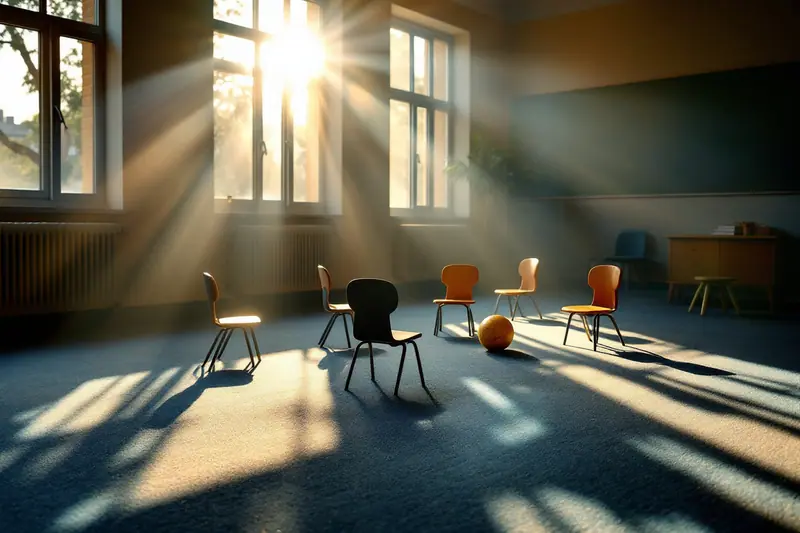
A teacher who wants to try something before any policy exists can do this on a Thursday. Chairs in a ring, a soft ball as talking piece, and the teacher seated like everyone else. Round one: your name and the best thing you ate this week. Round two: something that helps you when you are in a bad mood. Passing is allowed. End by thanking the group. Make no comment on any answer.
Do it for five Thursdays before changing a word of the rules. Broader group habits for young people are covered in the pages on nonviolence and on seeing, judging and acting, and there is a year of suitable dates in the calendar of days.
Filed on: Peace and Reconciliation